

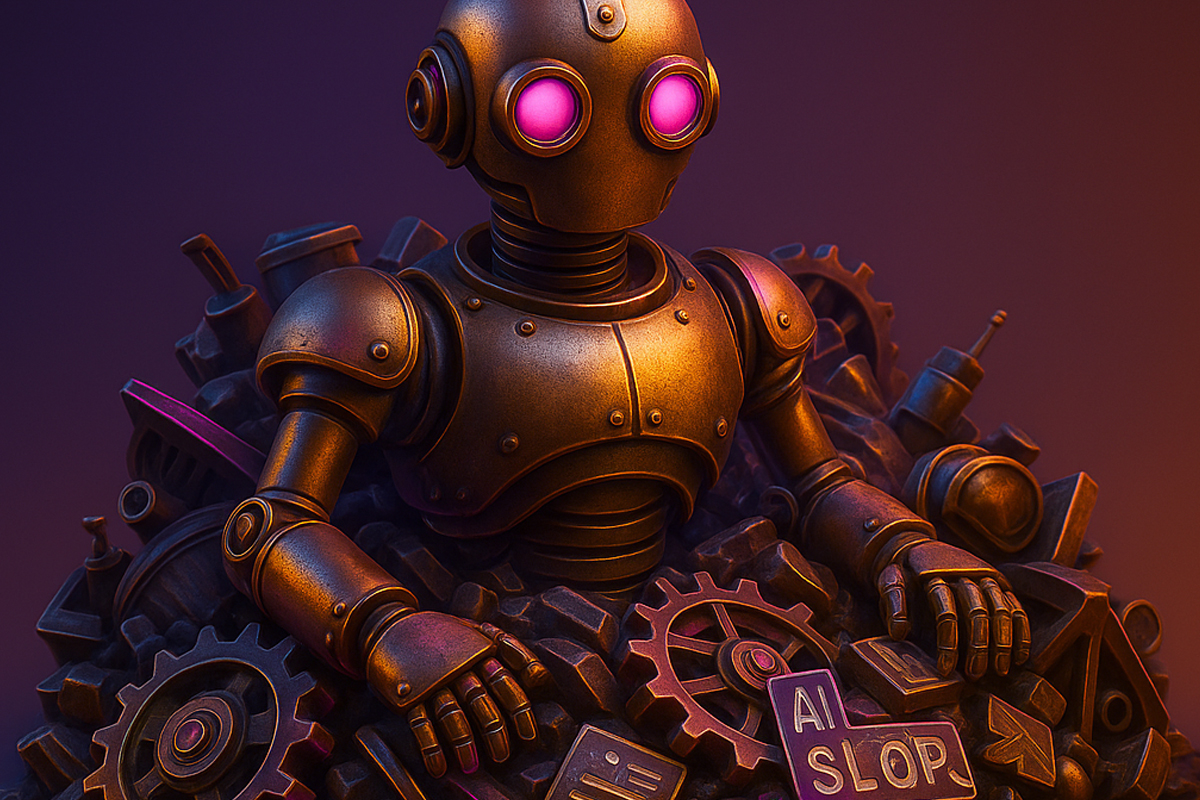
TL;DR:
AI didn’t break writing; people did. “AI slop” isn’t what machines create. It’s what humans publish without reading. Automation can multiply your reach or your mediocrity, depending on how awake you are when you hit “post.” If you’re using AI to create, fine, but for the love of God, read your output before you share it.

Chris Foley
Founder & head honcho over here at PXLPOD Web StrategyHere’s my own stab at this thing called AI Slop. You may have read Part 1 of this series written by my actual GPT. I think he made his case very well. Let’s see if I can add anything of my own.
I’m seeing AI Slop all over the place, and some of my own customers are guilty of wading into this Swamp of Sadness. I’ve been able to reach in and pull a couple of them out before they go full Artax on us. (if you know, you know.)
AI Slop Is Real (and It’s Our Own Fault)
We’ve all seen it, those uncanny, overpolished, too-symmetrical sentences that sound like someone let an HR department write poetry. It repeats itself, sounds vaguely impressed with itself, and says things like:
“At Acme Widgets and Sprockets, we believe…”
“At Acme Widgets and Sprockets, we…”
“At Acme Widgets and Sprockets…”
We get it. You believe.
This is what the internet’s calling AI slop: text that’s technically fine but spiritually vacant. It’s grammatically perfect, rhythmically numbing, and emotionally uninhabited. It reads like someone wearing a suit to mow the lawn.
But here’s the thing. AI doesn’t create the slop. Humans do.
Specifically, humans who stopped reading what they publish. READ. YOUR. OUTPUT.
Automation Without Attention
A funny pattern’s emerging. People will spend hours refining prompts, layering instructions, stacking agents, training voice models, and then, the second the system spits something out, they glance at it like a fortune cookie and call it done.
They don’t read it. They skim it. Maybe they scroll. Maybe they nod. Then they paste it into their CMS and hit publish.
That’s not creation. That’s delegation without oversight. Hey, AI employees require supervisors too.
The machine did its job. It produced language that looks correct.
But your job, the part with taste, voice, and intent, that’s still waiting on you.
AI Doesn’t Replace Craft, It Multiplies It
I use AI every day. PXLPOD’s content strategy runs on it. My own blog posts start as meeting transcripts fed through GPTs trained on my personal tone. I have an “editor GPT” that polishes and a “writer GPT” that stitches things together. It’s efficient, it’s eerie, and it’s me, but only when I take the time to read what comes out.
The bottleneck now isn’t writing, it’s reviewing.
It’s not “Can I generate this faster?”
It’s “Can I stand behind what was generated?”
I’ve got a queue of eight blog posts sitting in Drive right now. They’re good. They’re in my voice. But I still have to read them. Because I know that the second I stop doing that, the slop creeps in and takes over. Artax, no!
The Tell-Tale Signs of AI Slop
You can spot it in the wild.
AI slop always:
- Tries too hard to sound smart.
- Repeats key phrases like a nervous intern.
- Explains simple things like it’s writing an encyclopedia entry.
- Loves to use em dashes (don’t get me started).
- Builds elegant scaffolding for ideas that never arrive.
The trick isn’t to outlaw AI; it’s to out-edit it.
You train your model, then you train yourself to notice when the words start smelling like machine oil.
The Human Layer
Editing is where meaning lives now.
That’s the new creative frontier. I’ve heard it said that the money is in the prompt. No no no. Prompting is easy. Especially now. With each iteration my prompts make less and less of a difference.
We used to sweat over blank pages. Now we sweat over slightly-too-perfect paragraphs. We don’t write from scratch as often; we rewrite. We curate. We shape. We humanize.
And that’s not regression. It’s evolution.
When Pausha runs my transcripts through our GPTs, what comes back is a draft that sounds a lot like me. But it’s still a draft. I have to go through line by line, tighten phrasing, kill redundancies, fix rhythm. It’s faster, but it’s not free.
AI gets me 80 percent of the way there, but that last 20 percent, that’s where your reputation lives.
The “I Approve This Message” Rule
Here’s where I’ve landed on all this. Before you hit send, before you post, before you hand anything to a client, read it. Every word.
If you can say out loud, “I approve this message,” then post it.
If not, fix it. Or delete it.
It’s that simple.
AI is a tool, not an excuse… you lazy bum.
Automation without attention is just faster failure — and it drags the rest of us down into the swamp with you.
The more of this shit people have to suffer the more likely people are to stop reading your messaging altogether. I feel like I can’t get out there and stop other people from poisoning the well (Only YOU Can Prevent Forest Fires…) but I can definitely do my part and not contribute to the fall of Western Civilization. On the other hand, to more of this shit people have to endure, the better chance you have of standing out. So there’s that.
Final Thoughts
There’s no shame in using AI to write. There’s shame in letting it write for you.
Machines can generate words, but they can’t mean them. That’s still your job.
And honestly, that’s the good part. That’s where the soul of communication still lives: in the edit, the pause, the reread, the “does this sound like me?” moment.
So yes, use the robots. Let them draft, transcribe, polish, and pace you.
Just don’t forget to be the human in the loop.
If you can’t bear to read your work, your audience won’t either. God knows it’s hard enough to get people to read anything anyway. If you’ve got someone on page reading your text you’re a winner of Olympic proportions – but before you go trying to match your belt to your new gold medal, do make sure you’ve written something worthy of their time.
Respect your readers. Respect your brand. Call your mom.
I’m Chris Foley and I Approve This Message.
Cheers,
Chris

Free Site Health Analyzer
Performance isn't a mystery and sometimes the answers are hiding in plain sight! This is the same audit tool we use to test our own websites.Get your reportIt's Instant. Like Magic.