
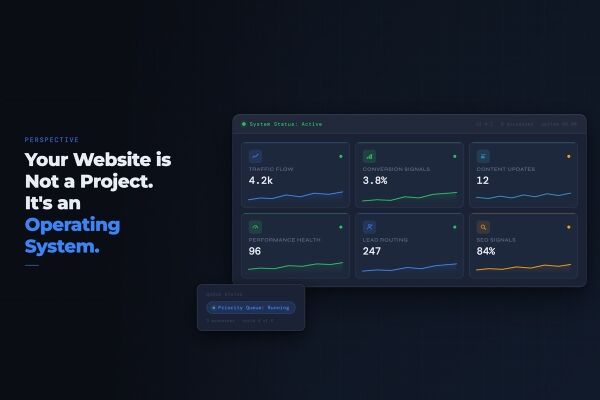
TL;DR:
Projects get budgets and deadlines. Operating systems get updates, maintenance, monitoring, and evolution.
The businesses that understand this win quietly. The ones that don’t keep opening trouble tickets and spend a lot of money catching up.

Chris Foley
Founder & head honcho over here at PXLPOD Web StrategyI’ve watched too many businesses celebrate a website launch like they just christened a yacht, only to treat it like a lawn ornament six months later. The internet does not reward neglect. It doesn’t care about your timeline, your budget, or how proud everyone felt on launch day.
If your site drives revenue, trust, or authority, it is not a marketing artifact. It’s infrastructure. And infrastructure either gets maintained deliberately, or it fails unpredictably.
The companies that quietly win aren’t the ones constantly rebuilding. They’re the ones paying attention.
Most businesses think their website is something you “launch.”
In reality, it behaves more like software infrastructure than marketing collateral.
Also, you don’t “launch” a bridge. You inspect it. Maintain it. Reinforce it. Or you live to watch it collapse.
The Project Illusion
Here’s how it usually goes.
You hire a designer.
You build the thing.
You review it seventeen times.
You launch. 🎉
You exhale.
You move on.
Budget exhausted. Team tired. Everyone proud, and tired.
Then six months later:
- Performance is drifting.
- Forms are glitching.
- A plugin hasn’t been updated since the Carter administration.
- Analytics look… weird.
- Traffic dipped and nobody knows why.
But hey — the project is done. Right?
This is the illusion.
Websites aren’t static assets. They don’t sit politely like brochures do. They’re living systems plugged into hosting environments, search engines, APIs, CRMs, plugins, browsers, devices, bots, and whatever Google has changed this week.
Launch is not the finish line. It’s the starting gun. (on your marks… get set… neglect!)
(We’ve already had this conversation about marketing not being “set it and forget it.” Same principle. Different layer.)
The Operating System Reality
Think about your phone.
It updates constantly.
Security patches.
Compatibility fixes.
Feature changes.
Performance improvements.
Your website is no different.
It has to respond to:
- Software updates (WordPress, plugins, PHP)
- Security vulnerabilities
- Browser changes
- Device shifts
- Traffic fluctuations
- User behavior evolution
- Bot traffic (and yes, that war is real)
And let’s not forget accessibility standards tightening, privacy laws evolving, and AI search systems deciding whether your site deserves to be seen.
This isn’t “maintenance.” It’s governance. It’s stewardship. It’s operational discipline.
The Hidden Cost of Reactive Management
Here’s where it gets expensive.
When you treat your website like a completed project, you only pay attention when something breaks.
That means:
- Emergency tickets instead of scheduled reviews
- Downtime instead of prevention
- Revenue impact instead of stability
- Stress instead of structure
You don’t notice performance erosion until conversions slip.
You don’t notice security drift until malware shows up.
According to Sucuri’s annual Website Threat Research Report, over 50% of hacked WordPress sites were running outdated software at the time of infection. (source)
You don’t notice hosting bottlenecks until your bounce rate spikes and your rankings quietly slide off a cliff.
Reactive management feels cheaper, but it never is.
It’s like skipping oil changes and acting surprised when the engine seizes.
What Mature Businesses Do Differently
The companies that treat their websites like core assets behave differently.
They:
- Allocate ongoing oversight.
- Schedule regular performance reviews.
- Build iteration into operations.
- Measure. Adjust. Refine.
They understand something simple: web performance is a function of consistency. Not genius. Not redesigns. Not dramatic overhauls every three years.
Consistency. The quiet, boring stuff wins.
(And yes, optimization is cultural. The best companies don’t “run campaigns.” They run feedback loops.)
The Infrastructure Layer
Let’s talk about the thing nobody wants to talk about.
Hosting.
Infrastructure determines your ceiling.
You can design the most beautiful experience in the world, but if it’s built on unstable hosting, you’ve capped your performance before you start.
Cheap hosting isn’t just slow. It’s inconsistent. And inconsistency erodes trust faster than ugly design ever could. Ain’t nobody got time for that.
Google’s research shows that as page load time goes from 1 second to 3 seconds, the probability of bounce increases by 32%. (source)
Fast, stable infrastructure isn’t glamorous. It’s not visible in a portfolio, yet it’s the difference between a site that feels modern and one that feels like it’s gasping for air. And hey, when your site doesn’t feel modern it costs your brand credibility. So there’s also that.
Your operating system is only as strong as the machine it’s running on.
Structured Stewardship
Growing businesses don’t rely on hope. They rely on systems.
They don’t assume:
“Someone will notice if something breaks.”
They decide:
“Someone is responsible for noticing before it breaks.”
It requires a shift from project thinking to operational thinking. From launch mindset to lifecycle mindset. From occasional redesign to structured stewardship.
When your website is directly tied to revenue, lead flow, authority, recruiting, customer support, or reputation — it deserves the same operational discipline as accounting or legal.
Closing Thought
If your website is critical to your revenue, it’s not a side project so maybe stop treating it like a hobby.
Your site is essential infrastructure, and infrastructure demands oversight.
Cheers,
Chris
Key Takeaways
- A website launch is not the finish line — it’s the starting point of an ongoing operational commitment.
- Websites are living systems connected to hosting environments, search engines, plugins, APIs, and browsers. They require continuous governance, not periodic redesigns.
- Reactive management — only paying attention when something breaks — is always more expensive than proactive oversight.
- Cheap or unstable hosting caps your performance ceiling before a single visitor arrives. Infrastructure is not optional.
- The companies that win online aren’t the ones who redesign constantly. They’re the ones who maintain consistently.
- SecurePod Care exists specifically for businesses ready to treat their website as core infrastructure rather than a completed project.

Free Site Health Analyzer
Performance isn't a mystery and sometimes the answers are hiding in plain sight! This is the same audit tool we use to test our own websites.Get your reportIt's Instant. Like Magic.
